Showing posts with label south bronx. Show all posts

Friday, January 15, 2010

The Weaver's: A Short Interview with Rammellzee


“We control your icons. We wrote them on your trains those big gigantic rolling pages...”


-Rammellzee, interview, Style Wars 2004 edition.


I first heard of The Rammellzee through my friend Chuck Galli, who interviewed him for a paper titled “Hip-Hop Futurism: Remixing Afrofuturism and the Hermeneutics of Identity.” Chuck directed me to Zee's website, where can be found the cryptic treatise/equation that the artist's name embodies, as well as some sculptural representations of the godheads who, as Zee sees it, fight for the domination of language.


Rammellzee has been active since the late seventies. As a member of that founding generation, he was and remains uniquely sensitive to the power of symbols and signifiers to generate and destroy worlds. Hip hop is a war of symbolic communication, and like a savant or kabbalist, Zee understands alphanumeric units not as pure abstractions, but as souls, and soldiers:


The letters are weapons. Instead of Orson Wells stating that...the books will be burnt. The books will stay there. The letters have left the page. And once it went up the letter had better be ready to fly.


-Rammellzee, Style Wars 2004 edition.


So, here is the interview:


[SC] You seem to have a unique understanding of language and its hidden powers.  And I am curious how you would describe your relationship to language, whether as a sculptor, emcee, whatever...


[RZ] The "Weaver's" have it! ZeeOut.


[SC] The Weaver's!? Who are the Weaver's, Zee?


[RZ] We are...and the others that migrated from the burnt out, bulletins, schools, fuzz,death. ZeeOut.


[SC] That reminds me of a verse I wrote once,


'Learn to weave, and time will bend for you,
it is a different art from drawing lines.'


Hard to put a finger on, but 'weaving' involves a different kind of consciousness than 'delineation,' which is the mode in which man-made environments, texts, works of art are usually built and experienced.  


And the tension between the two, as when an artist weaves over linear surfaces or spaces, as with subway graffiti and certain styles of rap, can be explosive.  What do you think?


[RZ] As like in the Gothics or the webs Futurism. z.


[SC] You know, language has been standardized to an amazing degree in the past few hundred years, thanks to the extension of public education, bureaucracy, communications networks.  But language, if left to its own devices, evolves very quickly, as evidenced by the many 'bastard' dialects that branched off from Latin after the fall of the Roman Empire.  


"Standard English" is basically a closed system.  There are rules of grammar, spelling, even pronunciation...which prevent us from changing it in any lasting way.  But there are some people who the forces of standardization do not reach--the young people of the old South Bronx, for example. And my question is, do you think this apparent disadvantage can sometimes free people to innovate or even restructure language?


[RZ] Due to the fact that in hip-hop or rap music, which are definitely 2 different things. Hip-Hop is for fun, rap is a mug shot for gangsters and war and pimps. Both are always business men or wombed-man. Emotionally it is impossible for the subject as slanguage. For if a white man can act like a black man but has forgotten that letters themselves were once racists by volume and diction. A black man thinks he owns A-Z and this rhythmic culture now noticed by the white man, makes the white man look impotent since Gutenberg's printing press and the Clergy.
White man thinks he has invented something called respect by disavowing the language of our language tree by thinking that the black man regurgitated from white man's indo-european germanic dialects.


[SC] People have probably asked you this before, but what do you think was the role of the five percenters in the development of hip hop culture?  Especially maybe from 1974-79, what you describe as “a war era, where knowledge formed about by itself through the body, in the dark, underground.”


[RZ] There was none. It was about Math and the Mapamatics of the body.


[SC] Where were you during the blackout of 1977?

[RZ] Madison Avenue. Zee OUT.

A Quick Intro

These pages explore the relationship between youth culture and the built environment of the South Bronx of the mid-to-late 1970s.  My initial thesis was that the experience of shock and displacement that characterized life in the poorest sections of the borough also informed the aesthetics of rap, graffiti, and break dancing.  Free from any anxiety of influence, early hip hop was unique among twentieth-century arts movements for its ability to re-present the here-and-now mimetically, ecstatically, and to transcend the banality of ghettoized life thereby.  
As it happens, the here-and-now of the old South Bronx was a dystopia of epic proportions, as well as a kind of allegory for all kinds of modern/postmodern crises both political and personal. “It is as if the Bronx,” writes Marshall Berman, “in the depths of its disintegration, came to symbolize the twentieth-century world.” [1.]  In recognition of this, I also consider what the lower borough’s collapse meant, if anything, to the metropolis and the nation.     
In a few posts, especially "The Spectacle of the Ruins," "The Valley of Ashes" and "Back Story / the Cross-Bronx Expressway," I discuss the postwar history of the borough leading up to the emergence of hip hop. Readers interested to know more might want to start with Jill Jonnes' South Bronx Rising and Evelyn Gonzalez's The Bronx.
Enjoy!


[1] Marshall Berman in his introduction to New York Calling: From Blackout to Bloomberg, ed. Marshall Berman and Brian Berger (London: Reaktion Books, 2007), 19.

Tuesday, January 5, 2010

Thoughts on Wild Style

"In some cases, when a people are freed from their past they are given an opportunity to start anew. Hip-hop, like its African American creators, is born of this newfound independence. It is our generation's opportunity to start from scratch."


- Saul Williams in The Dead Emcee Scrolls: The Lost Teachings of Hip hop

I saw Charlie Ahearn's Wild Style back-to-back with The Fire Next Door, the documentary noted on a previous post. Both are rich in footage of the old South Bronx, but those environs read very differently from one film to the next.  Fire Next Door documents the arson epidemic and the deadly mix of social/political problems of which fire was the most graphic symptom. The ruins as presented by Moyers call to mind the words scrawled on a project wall in Camilo Vergara's photo essay The New American Ghetto: "Help Me, Motherfucker."  


Those same ruins fill the frames of the proto-hip hop musical Wild Style, but they appear transfigured, charged with a strange power, outside of quotidian time and its imperatives.


Miles of burnt-out buildings and rubble heaps where kids played obliviously, '80 blocks' from midtown glitz--for sure, that was a failure of civilization, a failure specifically of American civilization to uphold its professed values, and people should know about it.


Nonetheless, the kids who actually lived that experience implicitly resisted the victim label that postwar liberalism stamped upon them. This was the constructive flipside of youth's conceit, and it informed the spirit of early hip hop culture.


Grandmaster Caz:


"Look past the garbage, over the trains,
under the ruins, through the remains,
around the crime and pollution,
and tell me, where I fit in,
South Bronx, New York,
that's where I dwell,
and to a lot of people its a living hell,
full of frustration and poverty,
but wait, that's not how it looks to me,
its a challenge, an opportunity,
to rise above the stink and debris,
you gotta start with nothing and then you build..."


- "South Bronx Subway Rap," Wild Style soundtrack


Wild Style condenses that youthful energy like a great poem, and re-presents the South Bronx as an enchanted place, however fraught with danger.  Look past, over, under, through, around...


***


To parallel the material disinvestment that occurred the South Bronx in the sixties came a disinvestment--for the middle classes at least--of meanings, memories, and the emotional attachments that make buildings more than just brick and mortar.  To outsiders and emigres, the South Bronx became a hieroglyph, a tabula of forms without any certain function, a grid-map of places without names.


The wasteland that remained presented itself as an invitation to creatively-minded kids--to  inscribe new meanings onto the artifacts of a vanished civilization; to re-arrange, re-mix, or break them.  This was the context of hip hop's development, "a challenge, an opportunity" to re-claim the uniquely human power to name, the lack of which normally renders the poor invisible. Seizing this power,  the progenitors of hip hop opened a site of revolutionary possibilities, and created art from within that void at the very center of civilization.

A.O. Scott writes that Wild Style "captures the utopian glimmerings of an era that is generally remembered as the darkest in the modern history of New York."  Indeed, the beauty of the movement that the film represents was its ability not to efface but to deflect that darkness, to relate to it as the mud in which creative genius seeded.

Tuesday, December 29, 2009

Hip Hop: La Musica de Las Ruinas

This essay, which I wrote in late 2007 for a Spanish composition class, was the seedling of the South Bronx research project. The main issue that I am wrestling with now, that is, the dialectic between the arts and the built environment, is introduced here. It's a bit reductionist, but still holds up pretty well...

Hip Hop: La Música de las Ruinas

A veces, la conexión entre la música y el paisaje es inequívoco: la guitarra reggae, con su sonido fresco y aireado, es el corolario natural de las brisas de las islas; las canciones roncas de los cléricos musulmanes, que llenan el espacio, sugieren el desierto vasto. En el hip hop, sin embargo, la marca del ambiente es menos clara. Pues es un género globalizado que ha sido extendido y recreado en casi todas partes. Mientras que algunas artes son inseperables de sus lugares de origen, el hip hop es muy plástico, y se adapta a una variedad de contextos culturales. Quizás es porque el ambiente de donde el rap vino (los barrios neoyorquinos) y la experiencia histórica que lo formó (el deteriorio de esos mismos barrios) reflejan un proceso global.
En Nueva York, durante los los sesentas y setentas, una generación de urbanistas puso sus tijeras en el mapa del barrio como si fueran dioses sastres. Los planes de renovación urbana resultaron en la demolición de barrios enteros, los cuales fueron sustituidos por viviendas públicas feas. Autopistas nuevas cortaron en trozos comunidades viejas. Fue un patrón nacional: entre 1949 y 1973, la renovación urbana destrosó unos 1,600 barrios afroamericanos [1]. Para los setentas, un sonido inédito emergió de estos lugares, el cual reflejó la fragmentación del ambiente urbano, y la monotonía de la vida en las viviendas nuevas. El sentido de choque y paralysis—el estético de interrupción (tan psicológica como geográfica) crearon el género del hip hop como el corolario del ambiente.
Paul D. Miller, autor y artista de música electrónica, introdujo la noción del “corte” como manera de entender la cultura global, y el hip hop en particular:

“La palabra “corte” me hace pensar sobre las carreteras y autopistas que cortan a través del paisaje. Cuando se va en avión sobre las areas urbanas principales, se ve el campo, y entonces, poco a poco se hace mas geométrico, con calles talladas en la tierra. Cuando se llega al Manhattan o otro centro, se ve muchos estratos geométricos, capas de cortes. El urbanista Robert Moses arrasó con mucho del Bronx para construir sistemas de autopistas. Cortó a través de lo que eran, antes, estratos diferentes de clases. Guetos fueron mucho más afectados por este proyecto de carreteras que otras comunidades. Eso influyó como la gente miraba a la comunidad, lo cual afectó a la música hip hop” [2].

Es decir, la fragmentación del espacio físico informó el sonido del hip hop—la repetición de la batería, las melodías simples y crudas, y el elemento de choque—todos son los productos orgánicos de un ambiente gastado.
Además, ese ambiente no es único. En el 2007, por la primera vez, la mayoría de la población del mundo vivirá en ciudades; y la mayoría de esas ciudades son como los barrios descuidados de Nueva York [3]. Por eso, no es sorpresa que la banda que toca mientras el mundo entero baila hacía el borde del abismo, toca hip hop.

1. Mindy Thompson Fullilove, M.D. Root Shock: How Tearing Up City Neighborhoods Hurts America, and What We Can Do About It. One World/Ballantine Books, June 2004.

2. Carol Becker; Romi Crawford, Paul D. Miller. “An Interview with Paul D. Miller a.k.a. Dj Spooky—That Subliminal Kid.” Art Journal, Vol. 61, no. 1. (Spring 2002), p. 85. El texto original: “The word cut makes me think about roads and highways cutting across the landscape. Flying over major urban areas you see the countryside, and then slowly it becomes more geometric, with roads carved into the land. By the time you get to Manhattan or another center, you see all these geometric stratifications, layers of cuts. The urban planner Robert Moses leveled much of the Bronx to build highway systems. He sliced through what was then different layers of class. Ghetto communities were much more affected by this road-building project than others were. That influenced how people viewed community, which affected hip hop music.”

3. United Nations Population Fund. “Urbanization: A Majority in Cities.” Website: http://www.unfpa.org/pds/urbanization.htm. (Accessed November 2006).

Wednesday, December 23, 2009

Back Story / The Cross-Bronx Expressway


The South Bronx showed signs of distress from the thirties onwards: disinvestment, the loss of industry, ethnic tensions, and an absence of owner-occupied housing each exerted an adverse influence. With the forties and fifties came the clustering of low-income, racially segregated housing in already fading neighborhoods; the precipitous influx of poor Southern blacks and Puerto Ricans, a heroin epidemic, an increase in gang violence, and the proliferation of cheap suburban houses to speed the departure of the white middle class. And as Marshall Berman argues, the construction of the Cross-Bronx Expressway from 1948 to 1963 turned problems into pathologies, to all but seal the fate of the area.
What became the South Bronx after the war was a series of boom neighborhoods before it: Mott Haven, Melrose, Morrisania, and Hunts Point-Crotona Park East had all been swallowed by the grid by the 1920s, and welcomed upwardly mobile Jews escaping the slums of Manhattan’s Lower East Side. [1] But as fast as the district swelled, its middle class residents found incentives to move on, including new transit lines that tied the city to areas farther north in the 1920s, and the simultaneous shift of Bronx civic and cultural life westward to the lower Grand Concourse.
Those of means began to move, while working-class families stayed behind, to be joined by a culturally distinct and generally poorer wave of Puerto Ricans and African Americans whose numbers steadily rose throughout the forties. [2]
Buildings languished as capital shifted to the suburbs. The few new structures built in the 1930s, including a community health center and a sewage treatment plant, did little to enhance neighborhood prestige. And by 1940, local banks and federal lenders alike had redlined the entire South Bronx, which came to be known as the poorest, oldest, and least fashionable section of the borough. Sixty-six percent of relief cases were concentrated there, and the Bronx Board of Trade recommended the area for three of four proposed low-rent public housing projects, thus cementing its reputation as a new slum. [3]
“By the 1940’s,” Evelyn Gonzalez concludes, “the South Bronx no longer met middle class expectations.” People aspired to own their homes, but in the South Bronx, rental apartments comprised ninety percent of all dwellings, and wartime rent controls (which remained in place for decades after) dissuaded tenants from becoming landlords. Instead of anchoring families, therefore, the neighborhoods seemed designed to promote transiency. [4]
Directly north of Morrisania, the East Tremont neighborhood marked the informal boundary line between slums and not-slums. With corroding pipes and few elevators, its housing was not the best in the city, but for the quality of its schools, parks, and recreation centers; the neighborhood “had held” in the forties against the forces at work to its west and south, and this in spite of having rents as low as the Lower East Side or Harlem. While the southern neighborhoods experienced a steady population transfer in the 1940s, trading Jews for African Americans and Puerto Ricans, East Tremont diversified, retaining much of its existing population while absorbing newcomers slowly and, as some argue, successfully. In Robert Caro’s The Power Broker: Robert Moses and the Fall of New York (1974), Cele Cohen, a former resident of East Tremont recalls, “We used to have negro children over for dinner, and they used to have my daughter over. To tell the truth, we didn’t think that way—you know, the way it is now—then.” [5]
Whether all white residents were as gracious is doubtful, but through interviews with former residents, Robert Caro makes a strong case that “the neighborhood was holding just fine,” and in fact provided a crucial service to the city as an “urban staging area,” where migrants new to city life could transition within the framework of a stable, ethnically diverse community. [6] Contrast this to the high-rise public housing built after the war, which served to informally segregate the poorest New Yorkers from the city’s civic and cultural life. “If the city was going to endure,” Caro argues, neighborhoods like East Tremont were going to have to endure. And if left alone, this neighborhood would.” [7]
Sadly, we will never know, for a destructive force not rivaled by any to come before it was due to arrive, or rather fall on top of, East Tremont in 1948: the Cross-Bronx Expressway. And whereas the neighborhood’s pre-exisitng troubles were the fault of no one and everyone at once—brought on by cultural and racial attitudes, disinvestment, and age—the proposal to dig a six-lane wide, seven-mile long ditch through the heart of the borough was a deliberate plan “made finally on all levels of government, to sacrifice the poor and middle class, the communities in change as well as the stable communities of the mid-Bronx, to the arrogant dreams of engineers, politicians, and real estate developers.” [8]
The mastermind behind the Cross-Bronx was City Construction Coordinator Robert Moses, who conceived of it as a way to remove through traffic from the city's narrow and congested streets by connecting the Bronx-Whitestone Bridge in the east with the George Washington Bridge over the Harlem River in the west. To do so, the expressway would need to burrow through miles of high-density streets, sewers, water and utility mains “numbering in the hundreds,” a subway line, three railroads, and five elevated transit lines. [9] But as ambitious, as Faustian, as the expressway plan may have been, it was only one of several cross-city super-roads on Moses' drafting table in the mid-forties which, all told, would graft “more than a hundred miles” of asphalt onto the urban grid. Moses biographer Robert Caro helps to put the scope of the thing in perspective: “...lump together all the superhighways in existence in the all the cities on earth in 1945, and their mileage would not add up to as many miles as Robert Moses was planning to build in one city.” [10]
Moses first publicized the plan in the February-March 1944 edition of Bronxboro, the magazine of the Bronx Board of Trade. A year later, in the same paper, he proclaimed that “its effects on the borough will be enormous, and few people outside the public officials involved can visualize the future which these and other postwar improvements will usher in.” [11]
But in Bronx neighborhoods where few families owned cars, where subways, buses, and leg muscles “defined the flow of [people's] lives,” the future must have felt like a steamroller crushing heads. Gotham's Dr. Faust understood as much, and even delighted in the dramatic spectacle of worlds collapsing. “When you operate in an overbuilt metropolis,” he would later say, “you have to hack your way with a meat ax.” [12]
When a route was chosen in 1944, a route through blocks of solid apartment buildings, the expressway plan was met with vocal resistance in the neighborhoods that lined its future path. Over thirty civic, religious, and veterans' organizations united to form the “Cross-Bronx Citizens' Protective Association” in early 1946, and rallied around the issue of New York's housing shortage, which land clearance for the road would only exacerbate. [13] “Instead of homes,” the group argued, “our public officials are cramming highways down the throats of our veterans.” [14]
In East Tremont, the first eviction notices arrived in December, 1952. With “no funding in sight,” and no legal powers of enforcement, Moses ordered tenants to vacate within ninety days, “to shake'em up a little and get'em moving,” as one staffer recalls. And with county, city, state, and federal officials all in bed with Moses, most residents felt that they had no recourse. Most began to move. A steady stream of eviction notices masquerading as court orders helped to expedite the process, so that by 1955, all the buildings to which the city had taken title stood empty. [15]
Staffed by friends of Moses, the city's Real Estate Bureau was appointed to relocate tenants “in an orderly manner,”but did virtually nothing save to scare its charges away with the issue of imperious letters and the withdrawal of services. When 159 East Tremont buildings were transferred to the city in January 1954, heat and hot water were “almost simultaneously” cut off. Trash accumulated, “halls got dirty,”and empty units were left unguarded. By night, vandals, vagrants, and addicts took over, leaving scratch marks on the doors of remaining tenants. By day, demolition crews performed rough surgery on half-empty buildings. In Caro's The Power Broker, resident Lillian Edelstein remembers that “as soon as the top floor of a building was empty, they'd start tearing the roof and the top stories, even. While people were still living in it, they were tearing it down around their heads!.” [16]
Since the war, many Bronx families had been kept in place by the city's rent-stabilization law, and the only apartments at costs comparable to their own were to be found in the crumbling streets of poverty-stricken Harlem. Unwilling to “move down,” but priced out of the suburbs, the least affluent simply moved “from one condemned building to another” along the route of the coming expressway, enduring a chronic and deliberate lack of services, and getting slapped with rent hikes from landlords trying to recoup their losses. [17]
Five years lapsed between the last evictions and the completion of the East Tremont section of the Cross-Bronx (896), five years during which the neighborhood was rocked by dynamite blasting and shrouded in rock dust. On Southern Boulevard and Marmion, stores were cordoned off and deprived of customers. As Marshall Berman recalls, the Bathgate Avenue open market, “still flourishing in the late 1950s, was decimated; a year after the road came through, what was left went up in smoke.” Walls and ceilings cracked in buildings full of people, while “unsealed vacant stores and disemboweled buildings adrift in rubbish and broken glass became play spots for local children.” [18]
When a road is cut through the Amazon, the sudden infusion of harsh, unmitigated sunlight begins to kill the surrounding vegetation, and the devastation spreads deep into the ecosystem. A comparable thing happened in the Bronx when the blight of buildings abandoned along the Cross-Bronx invited crime, vagrancy, ruination, and then further abandonment in the streets beyond. In East Tremont, the 3,000 people living right up against the road moved first, to be followed by the other 7,000 who were their neighbors, and so on. A border vacuum if ever there was one, the highway “turned potential long-range entropy into a sudden inexorable catastrophe.” [19]
Catastrophe—”It was a catastrophe for the people up here,” recalled Bronxite historian John McNamara. Indeed, though many of the South Bronx's longtime residents defied postwar trends and stayed put, the incidental effect of the Cross-Bronx Expressway was to send the holdouts running for the hills, and only the oldest and poorest resigned to being “engulfed by the pursuing slum.” [20]

1. Evelyn Gonzalez, The Bronx (New York, NY: Columbia University Press, 2004), 94; Robert Caro, The Power Broker: Robert Moses and the Fall of New York (New York, Vintage Books, 1975), 851.

2. The city’s African American population was 450,000 before the war, 800,000 after. Sixty percent joined the relief rolls during the Great Depression. See Jill Jones, South Bronx Rising: The Rise, Fall and Resurrection of an American City (New York, NY: Fordham University Press, 2002), 98; Gonzalez, 97.

3. Gonzalez, Bronx, 106, 149, 102; The spots the Board of Trade recommended were “ between the factory district and 138th Street in Mott Haven; from 165th Street to Tremont Avenue in Morrisania and Claremont; and nearby the Longwood Avenue, Kelly, and Fox streets juncture in Hunts Pont.” See Gonzalez, 107.

4. Ibid., 109, 97, 109; Jonnes, 103.

5. Caro, Power Broker, 851, 857, 856, 857.

6. Ibid., 857.

7. Ibid., 859.

8. Grace Paley, introduction to In the South Bronx of America, Mel Rosenthal (Willimantic, CT: Curbstone Press, 2000), 11. Paley, born in 1922, grew up in the South Bronx.

9. Jonnes, Bronx Rising, 120-121.

10. Caro, 839.

11. Bronxboro, 2-3, 1945. Found in Jonnes, 119-120.

12. Caro, 849.

13. According to Caro, the city's postwar vacancy rate was “a habitual 1 percent.” P. 855.

14. Jonnes, 121.

15. Caro, 862, 882; Jonnes, 122.

16. Caro, 880-81; Jones 122; Caro, 860-61; Gonzalez, 116; Caro, 882.

17. Ibid., 861.

18. Ibid., 896, 877,887; Jonnes, 123; Berman, 293; Jonnes, 123.

19. Berman, All That is Solid.

20. Matt Sedensky, “Bronx Up Close: Decades Later, Doing the Cross-Bronx Expressway Right,” New York Times, 7 October, 2001, p.728; Gonzalez, 147.

Image credit: I took that picture in Fall 2009. You can do what you want with it.

The Valley of Ashes


For the millions watching from afar, the crumbling, emptying, burning South Bronx becomes a stage of symbolic communication. It communicates because it must, but the message is scrambled and bound to be misunderstood. For the absent middle class who tour the urban maelstrom through newspapers, magazines, and movies, the disintegration of the South Bronx signals that big-city culture has no place in the future America. The city--or so they believe--had only ever been a place to leave.
It would be silly to blame the middle class for the ruination of the South Bronx. Yes, they turned their backs on the city, but the left-behinds would have done the same had they been given the choice. Nonetheless, it is important to keep in mind that the collapse of the inner city could have been prevented—could have been, if not for the power of a peculiarly middle-class social vision, which was actuated by governmental policy and the redirection of capital to the suburbs.
As a child of the Bronx, Marshall Berman asks “Why did it go? Did it have to go? Was there anything we could have done to keep it alive?” He concludes that there was not, because the younger people of the Bronx were “possessed, inspired, by the great modern dream of mobility.” [1] Where once it had sustained them, in the postwar years that dream worked against cities everywhere, and was as decisive an influence on the fate of the South Bronx as any quantifiable factor.
In the early twentieth century, New York was a place to escape to, not from. But in the prosperous postwar years, the big-city skyline looked suddenly small against the vast horizons that automobile culture was opening up. The future, people learned, was to be found in greener pastures.
For the young people of the Bronx, a trip to the 1939 New York World's Fair—“The World of Tomorrow” as it was called—was a means of imaginative participation in this new American order. “TIME TEARS ON” was the slogan greeting entrants to the grounds, and indeed, it promised the obliteration of their cramped little world. [2]
The centerpiece of the fair was a monumental obulusk called the Trylon, connected to a dome the size of a lesser moon, called the Perisphere. From ground level, visitors entered the Trylon and rode up a set of moving stairs called an escalator. Part way up the structure, visitors were deposited onto moving rings that glided into the Perisphere. Inside was an exhibit called “Democracity,” which the Official Guidebook described as the “symbol of a perfectly integrated, futuristic metropolis pulsing with life and rhythm and music.” Artificial stars in the upper half of the dome illuminated a miniature cityscape of white surfaces and smooth, curving forms, in which five pristine suburbs housing a half-million workers circled an austere commercial center. [3]
In a separate exhibit sponsored by General Motors, the postwar public works of Robert Moses were prophesied. Called “Futurama,” it was a thirty-six thousand square foot model of the auto manufacturer’s ideal America. The year was 1960, and the city had been reinvented as a collection of skyscrapers in the shape of cathode ray tubes, dispersed along spacious lots and criss-crossed with seven lane highways, on which the speed limit was one-hundred miles per hour. Green spaces abounded, and beyond the city limits was a Jeffersonian expanse of farms and meadows. Miraculously, slums and mills had vanished, along with the brick-and-mortar neighborhoods of A.D. 1940. [4]
The World's Fair popularized a social vision hatched by eccentric engineers and architects. It entranced a new generation of New Yorkers with its Apollonian clarity, and it is the silent actor in this story, the pull factor that can't be quantified.

1. Marshall Berman, All That is Solid Melts into Air (New York, NY: Simon and Schuster, 1982), 326.

2. See Joel Dinerstein, Swinging the Machine: Modernity, Technology, and African American Culture Between the Wars (Amherst: University of Massachusetts Press, 2003), 283.

3. David Nye, Electrifying America: Social Meaning of a New Technology, 1880-1940 (Cambridge: MIT Press, 1990), 371, 367; Thomas P. Hughes, American Genesis: A Century of Invention and Technological Enthusiasm, 1870-1970 (New York: Penguin, 1989), 300-302.

4. Stanley Applebaum,ed., The New York World’s Fair, 1939/1940: In 155 Photographs by Richard Wurtz and Others (New York: Dover Publications, 1977), 20.

Image credit: Found at website "1939 New York World's Fair," (http://www.pmphoto.to/worlds_fair/index.htm) accessed December 23rd, 2009. From the website: "Trylon & Perisphere, courtesy Irene Nelson. Image captured from movie shot by her father Sea Captain Erik Manvall (1902-1987) and transferred to DVD by Johnny Riert (residents of Sweden)."

The Fire Next Door

This afternoon I made a trip to the Lincoln Center library to see The Fire Next Door, CBS Reports with Bill Moyers (1977, produced and directed by Tom Spain), a TV news documentary that is probably the most vivid record of that era in any medium, and sadly one of the least accessible. My lingering impression, writing now on the 1 train back to my apartment, is of an eviscerated, sheet-white winter sky casting its cold light on brown and gray husks of buildings. Light that does not contrast with the darkness from broken windows but extends from it. The footage reminds me of downtown Providence in the 1980s, my walks to the central library or variety store with my grandmother in the sonic shadow of I-95, and the yawning emptiness of the streets, their suspension from the treadmill temporality of functioning society. Life on a broken treadmill floating in space.

The film opens with a team of firefighters battling an apartment blaze that is consuming the upper walls. The building looks sturdy and well-kept. A mustachioed man is carried down the smoky stairwell, looking dazed.

Then a panoramic shot of some erstwhile neighborhood, another tenement roasting on the horizon, and Bill Moyers says, "Once that smoke on the horizon signified industry..." In a span of ten years, we are told, 30,000 buildings destroyed by arson. A fire every hour of every day, for ten years.

Then we are introduced to officer Tony Bouza (sic?), former Bronx borough commander who was demoted to beat cop for his "unorthodox views." Tony reappears throughout the film, ruminating from behind the wheel of his patrol car in a slurry Italian-New York accent that makes you like him.

Some Tony quotes:

"We are creating here what the Romans did in Rome--we are creating a permanent underclass of unemployed and desperate people. They're kind of invisible you don't see them because they drop out of...they stop looking for jobs. They drop out of everything except the welfare rolls."

"...and if these people weren't permanently pacified on alcohol, they'd be a lot more visible."

"I would like to rub America's nose in this and say, take a look at it, if you wanna reject it go ahead, I just don't happen to think that that's the kind of society we live in...our inescapable responsibility is to bring society's attention to it."

Another scene: Moyers walks trough a lightless shithole in his tan-colored overcoat, explaining that a woman and her six children once lived here, paying three-hundred dollars a month for six rooms with "rats, roaches, leaky plumbing, and junkies urinating in the hall." He reports that she moved all her valuables, left some junk furniture, and torched the place to get pushed to the top of the waiting list for subsidized housing. Explains that the city of New York paid two-to-three-thousand dollars cash to families displaced by fire.

Another scene: Street-level pans while Moyers breaks down the real estate market in the South Bronx: "You can buy a large apartment building in the Bronx for less than a thousand dollars. By taking advantage of the city's three-year tax moratorium, you can collect several thousand a month while paying no taxes. Provide heat and services infrequently and only under duress. No maintenence. A few promises will keep the rents coming in until the tenants give up in disgust. Then, two-hundred dollars will buy you a first-class arson job. Federally subsidized fire insurance is required by law. A quick settlement, with few questions, puts you ahead by seventy or eighty thousand."

Another scene: Davidson Avenue in the West Bronx, a tree-lined street that, from what little the camera shows, seems to be holding up well. Moyers walks with a elderly black woman who is nicely dressed and half-smiling. She explains her very dire situation as if telling a funny story about something that happened once to someone else in some other place:

- When I moved over here as little as two-and-a-half years ago, it was quite a beautiful place. And serene, so I thought, until nightfall.

- You live alone?

- Yes...with my dugs.

- With your dogs...

- Three now...I had five, three were thrown off the ruf. I had six.

- Thrown off the roof?

- Yeah.

- By whom?

- Some pathetic little boys.

- Threw your dogs [downward hand motion]...off the roof!?

- Five flights, yes. Killed 'em.

- ...Why don't you move?

- There's people that don't wanna accept me with three dugs. So, rather than give them up, they're my friends, I stay in that abandoned building terrified.

- You stay in that abandoned building?

- Alone.

- Do you have heat?

- No heat [its wintertime], no hot water, no electricity, no....facilities.

- Well, howdya live, Miss Tat!? [sic?]

- Well, I have friends across the street. Two as a matter of fact. I go there and cook, and bring the food home. 'Riginally I had a hot plate and I could heat the food when it was cold but now I don't have that so mostly I eat out of restaurants...and I go to my friend's house to take a bath. Heh. One has to be social! [asthmatic laugh] Hah! Hah! Hah! [Moyers laughs too, more charmed by the woman than amused by her situation]

(This exchange takes place across from 1995 Davidson Avenue, a large horseshoe-shaped building that had also been abandoned. I am curious to see what it looks like today.)

Another scene: Moyers is in the apartment of a young mother, her hair wrapped snugly in a headscarf. The building has changed hands six times in nine years, and no one is sure who owns it now. The woman's apartment is very tidy, and many of the family's belongings are tucked away in boxes. A mattress still wrapped in plastic leans against the wall. The woman explains that the mice destroyed another mattress and so she will hold off using this one until they can find a better place, subsidized housing. The bathroom ceiling is partially collapsed and the wall looks badly stained with mildew. Written in neat black handwriting on a wall where the camera pauses are the "Supreme Mathematics," the numerology of the Nation of Gods and Earths (a spinoff of the Nation of Islam that would later influence a generation of rappers like Rakim, Nas, and the Rza):

1. Knowledge
2. Wisdom
3. Understanding
4. Culture or Freedom
5. Power
6. Equality
7. God
8. Build or Destroy
9. Born
0. Cipher

In the next scene, we meet a bedridden mother of eight who looks thirty-something but too weak to lift her head. She mumbles, "The bible says that...this system not gonna last too much longer anyway, so I don't worry about my health to that extent."

Moyers then talks to an elderly Irish woman, Mrs. Sullivan, while kids from her building watch idly. She is moving the next day, she says, because "They [other kids from the building] beat me up, they threw me down the stairs...all my windows are broken."

Suddenly, some cops whisk by Mrs. Sullivan, Bill Moyers and the CBS crew and into the building. The camera follows, and as it turns out, they were headed up to Mrs. Sullivan's apartment, where some kids had taken advantage of her absence to tear the place apart and upend all the moving boxes. She cries and trembles. "I can't stay here tonight!" she says as the police are halfway out the door. Moyers stops them and, aware of the camera, they help arrange for her to leave that same day.

Towards the film's end, we meet Maoist/activist Ramon Rueda and his group The People's Development Corporation. Rueda looks young beneath his unkempt beard and afro as he talks spiritedly about the group's first project, the unauthorized rehabilitation of a city-owned building. In Jill Jonnes' book South Bronx Rising, I remember reading that the basement of the PDC's adoptive building at 1186 Washington Avenue was rank with stagnant water where dead dogs were left to rot. The PDC made the place like new, and even added solar panels in the hope of one day making the neighborhood an entirely self-sufficient, Fourieresque city within a city. The construction crew was also to be the building's future residents, who earned their co-ops through sweat equity.

More about The People's Development Corporation in a later post.

Enough for now about The Fire Next Door, which can be seen by appointment at The New York Public Library Center for the Performing Arts, 40 Lincoln Center, Manhattan.

Tuesday, December 22, 2009

The Spectacle of the Ruins

DJ Spooky was asked if he thinks young artists should study history. His reply: “As someone who’s very into history, I would say yes. Then again, many of the more interesting developments happen when people don’t pay any attention to history.” [a]


As a casualty of the postwar urban crisis, the South Bronx was exceptional only for the scale of its ruins. By the end of the 1970s, neighborhoods from Mott Haven up to Fordham Road had reached a state of near-total loss.  Officials, landlords, and torches-for-hire abandoned, leveled and burned both derelict buildings and sound ones.

Marshall Berman wrote noted sardonically that “urban fires make great visuals.”  Indeed, for the millions watching from afar, the crumbling, emptying, burning South Bronx was a remote spectacle--fascinating, and sad perhaps, but not directly concerning. [1] For the absent middle class who toured the urban maelstrom through newspapers, magazines, and movies, the disintegration of the South Bronx confirmed that big-city culture had no place in the future America. The city, or so many believed, had only ever been a place to leave.

“The South Bronx is a remnant, a left-behind, for which there is no economic base and no economic need. It is a place that people avert their eyes from and use as a dump heap for our society." [3]
George Sternleib, 1973

“…the postwar highway era is here…” [4]
Robert Moses, 1945


In the urban north, the civil rights movement crossed invisible lines—it waged its battles in the theater of white-controlled public space, where the very presence of African Americans in numbers constituted a form of protest. But by the late 70's, in the wake of white flight to the suburbs, those public spaces had given way to private ones such as shopping malls in distant suburbs, and no-less-exclusionary virtual spaces such as the local nighttime news. Add to this the internal dislocations of the black community caused by “slum clearance,” the ethnic diversification of poverty after the Puerto Rican migration, and the estrangement of the black middle class from inner-city culture, and it is easy to see why in the 1970s, the civil rights movement lost much of the cohesion that accounted for its historic gains.

New York's mid-century migrants arrived to a city in the spasms of deep structural change. The enormity of this migration was rivaled only by the rapidity of low-skilled labor outsourcing.  From an industrial port city, New York was fast becoming a corporate capital with little to offer working-class people. From 1947 to 1976, the city lost a half million jobs to the enticement of cheaper labor in the South, in Mexico, and overseas. But in the optimism of the postwar years, few could see where this moving ground would take them, least of all perhaps the thousands of Puerto Ricans and Southern African-Americans who flooded the city in the forties and fifties, eager to escape their respective experiences of rural poverty and oppression. [5]

Citywide, New York's black population rose from 450,000 before the war to 750,000 after, while the Puerto Rican population increased from 61,000 to 246,000. The Bronx, meanwhile, was home to 160,000 Puerto Ricans and African Americans in 1950, with ninety-one percent in the South Bronx, clustered around Prospect and Westchester Avenues. By 1960, the Bronx housed 350,000 African-Americans and Puerto Ricans, 267,000 of whom were crammed into the southernmost neighborhoods. [6]

Among the 60,000 Puerto Ricans in the Bronx in 1950, only one in ten had finished high school, seventy percent had not finished the ninth grade, and hardly any arrived speaking English; Southern African-Americans were hardly better off. Hoping to find a land of opportunity, the majority only escaped their rural hells to end in more alien, more labyrinthine urban ones. As a welfare official of the time observed, “It is a great migration of people on the march towards dreams that have no foundation.” [7]

Absent jobs for which they were qualified, and in the face of poverty reinforcing prejudice, the only means of support for most was “welfare and, from 1964 on, the little that would trickle down from the federal government's 'Great Society' programs.” [8]

The South Bronx of the sixties was a place in rapid decline, but not a place without hope. In the heady days of grassroots activism and ethnocentric militancy, people from within and without fought doggedly for small gains, and a sense of community held in defiance of great adversities. But by the end of the decade, a sense of exhaustion had set in among residents, and a more overt display of cynicism prevailed among policy makers. The latter widely relinquished the South Bronx as a place “not worth saving.” [9]

Crime rates in the borough had quadrupled by the end of the sixties, owing in large part to an outbreak of heroin addiction among the city’s poor. In the Hunts Point section, as a New York Times study showed, only one in twenty residents could expect to die a natural death—“Most were dying in homicides or from drugs.” [10]

Job loss accelerated. Between 1970 and 1977, three-hundred companies had either folded or moved to the suburbs, and taken ten-thousand jobs with them. Already by 1973, unemployment in the South Bronx had reached thirty percent, and forty percent of residents were on relief. [11]

As if to fill the employment gap, a new generation of youth gangs proliferated. The Savage Skulls, the Cypress Bachelors, the Black Spades, the Spanish Mafia, the Reapers, and others collectively boasted about 9,500 members in 1973, who roamed the streets attacking addicts and pushers, and hiring themselves out to torch buildings for landlords.

All this while the social collapse of the South Bronx found graphic expression in a skyline writhing with a nightly average of thirty-three fires between 1970 and 1975. [12] By 1977, thirty-thousand buildings had been abandoned or burnt down, while garbage-strewn rubble heaps stretched all the way up to Fordham Road. [13] The fires claimed not only derelict buildings, but structurally sound and rehabilitated ones as well. On Charlotte Street in East Tremont, the housing was “far from substandard” only a decade earlier, but here as elsewhere, deliberate destruction led to a near-total loss of the built environment. [14]

Through these apocalyptic ruins, the South Bronx suddenly became “an international metaphor for human misery and collapse.” [15]  Incredibly, though, both the press and government officials blamed residents for the fires. Officials pressed to speak on the destruction sang a standard refrain: “the victims of the fires were 'fouling their own nests.'” Or as Senator Daniel Patrick Moynihan phrased it bluntly: “People don’t want housing in the South Bronx, or they wouldn’t burn it down.” [16]

Media echoed officials in shrugging off Bronx residents as crazed nihilists, but people were not burning their houses down, or at least not many.  As every tenement dweller knew, it was in fact their absentee landlords and the torches that the latter hired who set the great majority of fires.  As Evelyn Gonzalez explains, “When low-premium fire insurance became available in the 1970s, many investors bought Bronx apartment buildings with the express intent of burning them, while an untold number of Bronx property owners bought policies that made their buildings worth more dead than alive.” [17]


“For a generation,” writes Marhsall Berman, New York's ruins were its greatest spectacles.” So it was that in the seventies, all eyes were on the city once again. But the measure of fame was inverted, and a pageant of failures stole the show. In this post-industrial dis-order, the South Bronx became the new downtown, and Charlotte Street the new Great White Way. The ruins fascinated no less than the luminescent boulevards of years past, but what the spectators didn't perceive in this case were the hidden wires of causation that made them silent actors in the show.


a. Carol Becker; Romi Crawford, Paul D. Miller. “An Interview with Paul D. Miller a.k.a. Dj Spooky—That Subliminal Kid.” Art Journal, Vol. 61, no. 1. (Spring 2002), p. 85.

1. Marshall Berman, All That is Solid, Melts into Air: The Experience of Modernity, (New York: Simon & Schuster, 1982), 72.

2. Martha Rosler in Mel Rosenthal's In the South Bronx of America, (Willimantic, CT: Curbstone Press, 2000), 112.

3. George Sternleib, Director of the Center for Urban Policy Research at Rutgers University. Quoted in Martin Tolchin, “Future Looks Bleak for the South Bronx, ”New York Times 18 January, 1973, p. 85.

4. Quoted in “285,000,000 Roads Planned for City: The Folks Back in the Old Country Are Proud of New York City's Mayor-Elect,” New York Times, 26 November, 1945, p. 23.

5. Evelyn Gonzalez, The Bronx, (New York: Columbia University Press, 2004),118. Jill Jonnes, South Bronx Rising: the Rise, Fall, and Resurrection of an American City, (New York: Fordham University Press, 2002), 91-93; For a thumbnail sketch of the changing city, and the place of new migrants within it, see “Episode 7: The City and the World (1945-present),” of Ric Burns' New York: A Documentary Film (PBS, 1999).

6. Gonzalez, 110-111. Though statistically lumped together, blacks and Puerto Ricans often occupied separate streets. Evelyn Gonzalez writes : “Between 1950 and 1960, blacks filled in Central Morrisania, from Webster to Prospect avenues and from 163rd Street to just beyond Crotona Park South, an area that would remain predominantly black for the rest of the century. Puerto Ricans...fanned out from 138th Street, Southern Boulevard, Westchester Avenue, and Claremont Parkway, following the subway and elevated train routes into central Mott Haven, lower Morrisania, Claremont, and Hunts Point-Crotona Park East. The rest of the borough was still overwhelmingly white in 1960, still mostly of Jewish, Italian, Irish, and German ancestry.” p. 110.

7. Jonnes 102, 111.

8. Gozalez, 118.

9. Gonz., 126.

10. Rosenthal, South Bronx, 109. In 1960, there were 998 reported assaults in the borough; in 1969, there were 4256. In 1960 there were 1765 reported burglaries; by 1969, there were 29,976. Most of the crime occurred in the South Bronx. See Gonzalez, 120.

11. Martin Tolchin, “Future Looks Bleak for the South Bronx,” New York Times, 18 January, 1973.

12. Rosenthal, 18; Richard Plunz, A History of Housing in New York City, (New York: Columbia University Press, 1990),
323.

13. John J. O'Connor, “TV: 'Fire Next Door' Studies South Bronx Arson,” New York Times, 22 February, 1977.

14. “With a density of well over 500 units per acre, it was a vibrant neighborhood, consisting primarily of New Law tenements built after 1901.” Pluntz, 335-36.

15. Rosenthal, 18.

16. See Marshall Berman, “New York Calling,” Dissent, Fall 2007, 71-77; 72. The Senator is quoted from Judith Cummings, “Moynihan, at Badillo's Bid, Will Tour South Bronx,” New York Times, 21 December, 1978, p. B9.

17. Gonz., 120.


Saturday, December 19, 2009

Melle Mel


Read somewhere that the Furious Five's "The Message" was crafted at the urging of a record exec for some socially conscious material, that Flash and the guys initially resisted for fear that their core audience wouldn't dig it. Whether that's true or not, when Melle Mel drops knowledge, the air crackles.
I had always liked "The Message" ever since hearing it twelve or so years ago, the soundtrack to my getting lost in the Bronx as a teenager in my '82 Accord at 2 in the morning. Even if he had done nothing else--and he's had plenty of sublime lyrical moments--I would rank Melle Mel as one of the most gifted rappers on the strength of that song.
More recently, though, I saw his performance in the penultimate scene of the much-maligned movie Beat Street, which for the record, you can promptly stop and eject right after Mel's exit, or else endure a Broadway-style modern dance/break dance-fusion fiasco. The verse he contributes is thematically similar to "The Message," but even more urgent in tone. And thanks to the big-studio film quality, Mel's peculiar body language is impossible not to read; hand by the side then thrust forward open and facing down, as if to quiet a jumping dog at his feet or bless a city from atop a mountain, face scrunched up like a man in anguish.

Note that on the youtube link, Grandmaster Melle Mel comes on after the other guy. Also notice the street footage in the first minute or so.

"The rise and fall, the last great empire,
the sound of the whole world caught on fire,
the ruthless struggle, the desperate gamble,
the game that left the whole world in shambles,
the cheats, the lies, the alibis,
and the foolish attempt to conquer the skies..."

Monday, November 2, 2009

Breaks and Loops

My interest in the old South Bronx is inseparable from my interest in hip hop music. And what I love about later hip hop, especially the mid-nineties New York variety, is its abundant use of white noise to create musical texture. In the hands of RZA, 4th Disciple, El P and others, the subliminal sounds of city life are patterned into apparent meaning--rain on pavement, the hiss from an old radiator, arguing neighbors, an express train passing. Listen to that stuff for a while, and you'll begin to feel like the old man in Paul Auster's City of Glass, 'reading' the streets as if they formed a great big secret book.

Of course, finding patterns in the aural landscape and re-presenting them is basic to all musical grammars, and artists have done so in urban America since ragtime days if not earlier. What is unique about sample-based hip hop is the degree to which it works with "registers of the real" rather than representations; i.e., the difference between an actual train whistle and a harmonica that evokes one. The difference is not merely technical, it is also ontological.

But old-school hip hop, and by that I mean the bare-bones seventies stuff, built from breaks, isn't the sound of 'the streets.' It's the sound of society getting on in spite of 'the streets,' celebrating survival on a Saturday night at the T-Connection or the high-school gym to the beat of a wind-up funky drummer. It creates a temporary social space above and against the desolation of uptown nights; that same wonderland of glowing floor tiles and disco balls that helped Tony Manero to forget his shitty hardware store job for a few fleeting hours every weekend.

Only later would artists try to make music out of ambient noise, when the sampler became an essential tool of the trade. Not coincidentally, the tone of the music and of the culture in general changed with the advent of that machine from upbeat to uptight. Heads now kept time instead of hips, and "looking the negative in the face" became a defining feature of hip hop aesthetics. What I am suggesting is that the sampler abetted hip hop's obsession with 'street life' by making it possible to capture, edit and pattern the sonic traces of daily life to an unprecedented degree.

***

"The breaks" are an ur-form of sampling--hand-cranked loops that are always about to slide back into the same old shit. Limited to two turntables and a mic, djs/emcees had to speak the present in the borrowed musical grammar of the past. Though old school hip hop recontextualized disco, funk, and soul, it could not break those forms open, the way cops and shrinks break the expressions of filmed subjects down into hundreds of discrete, unwitting gestures.

Wednesday, October 28, 2009

Thurston Saw


In poor neighborhoods, history is a bit more legible, more transparent. Houses are less often painted, signs less often replaced, while abandoned buildings experience a long afterlife of slow decay. Within their walls, the artifacts of the distant-recent past sometimes remain for decades, suspended in time even as time accelerates for the world around.

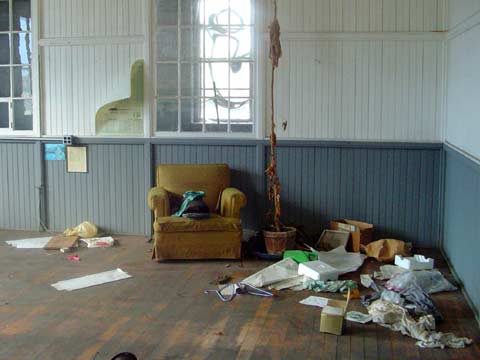
I remember visiting an empty Providence mill building in the mid-2000s with a friend. It was built in the 19th century and housed Thurston Manufacturing Co., maker of precision cutting saws, until its closure some time in the early 1990s. In the top floor office was a dried-up potted palm tree next to an orange armchair, the floor strewn with business letters and squatters' clothes. In a room nearby was a desk cluttered with blueprints and boiler reports going back to the 1930s. Amazing, that such ephemera could survive for more than a decade after abandonment. To be in a place like that, one feels the arrest of time, and it is a shock to the senses. Adjacent to Thurston Saw was Interstate 95, from which the angry drone of cars tearing by offered a perfect counterpoint to the stillness inside.

Thurston Saw has not made the switch to digital record keeping.
Thurston Saw does not accept web-based orders.
Thurston Saw does not enforce a no-smoking policy.

So what does this have to do with the South Bronx? Both the mills of Providence, RI and the neighborhoods of the South Bronx were casualties of the regional transition from an industrial to a 'knowledge-based' economy, along with the flight of jobs and capital to the suburbs. In both places, the built environment ceased to function as a dynamic symbol of progress, in effect ceasing to mark the passage of time-as-progress. The clock stopped for thirty years or so, and even now a few blocks remain unchanged from 'the bad old days.' To walk them is to slip through a crack in the edifice of our 'homogenous, empty time.' To do so without having to takes spirit, like opening a letter from a collections agency.

photo by Richard Townley.

Tuesday, October 20, 2009

The Global Village

Rap engages time in a unique and radical way, both through lyrical content (which invokes the past) and sampling (which appropriates its material artifacts). The influence of African diasporic cultures (especially Jamaican) and the creative possibilities opened by recording technologies are defining features of the music, and these are well known.

Less appreciated, I think, are the external adversarial forces that worked upon African-American culture in the early days of hip hop, forces that were deflected or 'flipped' into aesthetic practices. I am thinking of the postindustrial landscape of the South Bronx, where the physical decay and planned destruction of neighborhoods exposed strata of history and memory in brief flashes preceding total loss. It was a “permanent state of emergency,” and for young people, the formulation of a cultural-artistic response was a matter of life and death.

When I see pictures of the South Bronx in its saddest days, I am reminded of Walter Benjamin's 'angel of history':


There is a picture by Klee called Angelus Novus. It shows an angel who seems about to move away from something he stares at. His eyes are wide, his mouth is open, his wings are spread. This is how the angel of history must look. His face is turned towards the past. Where a chain of events appears before us, he sees one single catastrophe, which keeps piling wreckage upon wreckage and hurls it at its feet. Th angel would like to stay, awaken the dead, and make whole what has been smashed. But a storm is blowing from Paradise and has got caught in his wings; it is so strong that the angel can no longer close them. This storm drives him irresistibly into the future, to which his back is turned, while the pile of debris before him grows towards the sky. What we call progress is this storm.


The desire to “awaken the dead, and make whole what has been smashed”—this is the source of hip hop's continued vitality, and as the storm spreads to the new slums of the 'global village,' it is no wonder that the human casualties of progress adopt its basic forms.