Showing posts with label walter benjamin. Show all posts

Friday, January 15, 2010

The Weaver's: A Short Interview with Rammellzee


“We control your icons. We wrote them on your trains those big gigantic rolling pages...”


-Rammellzee, interview, Style Wars 2004 edition.


I first heard of The Rammellzee through my friend Chuck Galli, who interviewed him for a paper titled “Hip-Hop Futurism: Remixing Afrofuturism and the Hermeneutics of Identity.” Chuck directed me to Zee's website, where can be found the cryptic treatise/equation that the artist's name embodies, as well as some sculptural representations of the godheads who, as Zee sees it, fight for the domination of language.


Rammellzee has been active since the late seventies. As a member of that founding generation, he was and remains uniquely sensitive to the power of symbols and signifiers to generate and destroy worlds. Hip hop is a war of symbolic communication, and like a savant or kabbalist, Zee understands alphanumeric units not as pure abstractions, but as souls, and soldiers:


“The letters are weapons. Instead of Orson Wells stating that...the books will be burnt. The books will stay there. The letters have left the page. And once it went up the letter had better be ready to fly.”


-Rammellzee, Style Wars 2004 edition.


So, here is the interview:


[SC] You seem to have a unique understanding of language and its hidden powers.  And I am curious how you would describe your relationship to language, whether as a sculptor, emcee, whatever...


[RZ] The "Weaver's" have it! ZeeOut.


[SC] The Weaver's!? Who are the Weaver's, Zee?


[RZ] We are...and the others that migrated from the burnt out, bulletins, schools, fuzz,death. ZeeOut.


[SC] That reminds me of a verse I wrote once,


'Learn to weave, and time will bend for you,
it is a different art from drawing lines.'


Hard to put a finger on, but 'weaving' involves a different kind of consciousness than 'delineation,' which is the mode in which man-made environments, texts, works of art are usually built and experienced.  


And the tension between the two, as when an artist weaves over linear surfaces or spaces, as with subway graffiti and certain styles of rap, can be explosive.  What do you think?


[RZ] As like in the Gothics or the webs Futurism. z.


[SC] You know, language has been standardized to an amazing degree in the past few hundred years, thanks to the extension of public education, bureaucracy, communications networks.  But language, if left to its own devices, evolves very quickly, as evidenced by the many 'bastard' dialects that branched off from Latin after the fall of the Roman Empire.  


"Standard English" is basically a closed system.  There are rules of grammar, spelling, even pronunciation...which prevent us from changing it in any lasting way.  But there are some people who the forces of standardization do not reach--the young people of the old South Bronx, for example. And my question is, do you think this apparent disadvantage can sometimes free people to innovate or even restructure language?


[RZ] Due to the fact that in hip-hop or rap music, which are definitely 2 different things. Hip-Hop is for fun, rap is a mug shot for gangsters and war and pimps. Both are always business men or wombed-man. Emotionally it is impossible for the subject as slanguage. For if a white man can act like a black man but has forgotten that letters themselves were once racists by volume and diction. A black man thinks he owns A-Z and this rhythmic culture now noticed by the white man, makes the white man look impotent since Gutenberg's printing press and the Clergy.
White man thinks he has invented something called respect by disavowing the language of our language tree by thinking that the black man regurgitated from white man's indo-european germanic dialects.


[SC] People have probably asked you this before, but what do you think was the role of the five percenters in the development of hip hop culture?  Especially maybe from 1974-79, what you describe as “a war era, where knowledge formed about by itself through the body, in the dark, underground.”


[RZ] There was none. It was about Math and the Mapamatics of the body.


[SC] Where were you during the blackout of 1977?

[RZ] Madison Avenue. Zee OUT.

A Quick Intro

These pages explore the relationship between youth culture and the built environment of the South Bronx of the mid-to-late 1970s.  My initial thesis was that the experience of shock and displacement that characterized life in the poorest sections of the borough also informed the aesthetics of rap, graffiti, and break dancing.  Free from any anxiety of influence, early hip hop was unique among twentieth-century arts movements for its ability to re-present the here-and-now mimetically, ecstatically, and to transcend the banality of ghettoized life thereby.  
As it happens, the here-and-now of the old South Bronx was a dystopia of epic proportions, as well as a kind of allegory for all kinds of modern/postmodern crises both political and personal. “It is as if the Bronx,” writes Marshall Berman, “in the depths of its disintegration, came to symbolize the twentieth-century world.” [1.]  In recognition of this, I also consider what the lower borough’s collapse meant, if anything, to the metropolis and the nation.     
In a few posts, especially "The Spectacle of the Ruins," "The Valley of Ashes" and "Back Story / the Cross-Bronx Expressway," I discuss the postwar history of the borough leading up to the emergence of hip hop. Readers interested to know more might want to start with Jill Jonnes' South Bronx Rising and Evelyn Gonzalez's The Bronx.
Enjoy!


[1] Marshall Berman in his introduction to New York Calling: From Blackout to Bloomberg, ed. Marshall Berman and Brian Berger (London: Reaktion Books, 2007), 19.

Tuesday, January 5, 2010

Thoughts on Wild Style

"In some cases, when a people are freed from their past they are given an opportunity to start anew. Hip-hop, like its African American creators, is born of this newfound independence. It is our generation's opportunity to start from scratch."


- Saul Williams in The Dead Emcee Scrolls: The Lost Teachings of Hip hop

I saw Charlie Ahearn's Wild Style back-to-back with The Fire Next Door, the documentary noted on a previous post. Both are rich in footage of the old South Bronx, but those environs read very differently from one film to the next.  Fire Next Door documents the arson epidemic and the deadly mix of social/political problems of which fire was the most graphic symptom. The ruins as presented by Moyers call to mind the words scrawled on a project wall in Camilo Vergara's photo essay The New American Ghetto: "Help Me, Motherfucker."  


Those same ruins fill the frames of the proto-hip hop musical Wild Style, but they appear transfigured, charged with a strange power, outside of quotidian time and its imperatives.


Miles of burnt-out buildings and rubble heaps where kids played obliviously, '80 blocks' from midtown glitz--for sure, that was a failure of civilization, a failure specifically of American civilization to uphold its professed values, and people should know about it.


Nonetheless, the kids who actually lived that experience implicitly resisted the victim label that postwar liberalism stamped upon them. This was the constructive flipside of youth's conceit, and it informed the spirit of early hip hop culture.


Grandmaster Caz:


"Look past the garbage, over the trains,
under the ruins, through the remains,
around the crime and pollution,
and tell me, where I fit in,
South Bronx, New York,
that's where I dwell,
and to a lot of people its a living hell,
full of frustration and poverty,
but wait, that's not how it looks to me,
its a challenge, an opportunity,
to rise above the stink and debris,
you gotta start with nothing and then you build..."


- "South Bronx Subway Rap," Wild Style soundtrack


Wild Style condenses that youthful energy like a great poem, and re-presents the South Bronx as an enchanted place, however fraught with danger.  Look past, over, under, through, around...


***


To parallel the material disinvestment that occurred the South Bronx in the sixties came a disinvestment--for the middle classes at least--of meanings, memories, and the emotional attachments that make buildings more than just brick and mortar.  To outsiders and emigres, the South Bronx became a hieroglyph, a tabula of forms without any certain function, a grid-map of places without names.


The wasteland that remained presented itself as an invitation to creatively-minded kids--to  inscribe new meanings onto the artifacts of a vanished civilization; to re-arrange, re-mix, or break them.  This was the context of hip hop's development, "a challenge, an opportunity" to re-claim the uniquely human power to name, the lack of which normally renders the poor invisible. Seizing this power,  the progenitors of hip hop opened a site of revolutionary possibilities, and created art from within that void at the very center of civilization.

A.O. Scott writes that Wild Style "captures the utopian glimmerings of an era that is generally remembered as the darkest in the modern history of New York."  Indeed, the beauty of the movement that the film represents was its ability not to efface but to deflect that darkness, to relate to it as the mud in which creative genius seeded.

Tuesday, December 22, 2009

The Spectacle of the Ruins

DJ Spooky was asked if he thinks young artists should study history. His reply: “As someone who’s very into history, I would say yes. Then again, many of the more interesting developments happen when people don’t pay any attention to history.” [a]


As a casualty of the postwar urban crisis, the South Bronx was exceptional only for the scale of its ruins. By the end of the 1970s, neighborhoods from Mott Haven up to Fordham Road had reached a state of near-total loss.  Officials, landlords, and torches-for-hire abandoned, leveled and burned both derelict buildings and sound ones.

Marshall Berman wrote noted sardonically that “urban fires make great visuals.”  Indeed, for the millions watching from afar, the crumbling, emptying, burning South Bronx was a remote spectacle--fascinating, and sad perhaps, but not directly concerning. [1] For the absent middle class who toured the urban maelstrom through newspapers, magazines, and movies, the disintegration of the South Bronx confirmed that big-city culture had no place in the future America. The city, or so many believed, had only ever been a place to leave.

“The South Bronx is a remnant, a left-behind, for which there is no economic base and no economic need. It is a place that people avert their eyes from and use as a dump heap for our society." [3]
George Sternleib, 1973

“…the postwar highway era is here…” [4]
Robert Moses, 1945


In the urban north, the civil rights movement crossed invisible lines—it waged its battles in the theater of white-controlled public space, where the very presence of African Americans in numbers constituted a form of protest. But by the late 70's, in the wake of white flight to the suburbs, those public spaces had given way to private ones such as shopping malls in distant suburbs, and no-less-exclusionary virtual spaces such as the local nighttime news. Add to this the internal dislocations of the black community caused by “slum clearance,” the ethnic diversification of poverty after the Puerto Rican migration, and the estrangement of the black middle class from inner-city culture, and it is easy to see why in the 1970s, the civil rights movement lost much of the cohesion that accounted for its historic gains.

New York's mid-century migrants arrived to a city in the spasms of deep structural change. The enormity of this migration was rivaled only by the rapidity of low-skilled labor outsourcing.  From an industrial port city, New York was fast becoming a corporate capital with little to offer working-class people. From 1947 to 1976, the city lost a half million jobs to the enticement of cheaper labor in the South, in Mexico, and overseas. But in the optimism of the postwar years, few could see where this moving ground would take them, least of all perhaps the thousands of Puerto Ricans and Southern African-Americans who flooded the city in the forties and fifties, eager to escape their respective experiences of rural poverty and oppression. [5]

Citywide, New York's black population rose from 450,000 before the war to 750,000 after, while the Puerto Rican population increased from 61,000 to 246,000. The Bronx, meanwhile, was home to 160,000 Puerto Ricans and African Americans in 1950, with ninety-one percent in the South Bronx, clustered around Prospect and Westchester Avenues. By 1960, the Bronx housed 350,000 African-Americans and Puerto Ricans, 267,000 of whom were crammed into the southernmost neighborhoods. [6]

Among the 60,000 Puerto Ricans in the Bronx in 1950, only one in ten had finished high school, seventy percent had not finished the ninth grade, and hardly any arrived speaking English; Southern African-Americans were hardly better off. Hoping to find a land of opportunity, the majority only escaped their rural hells to end in more alien, more labyrinthine urban ones. As a welfare official of the time observed, “It is a great migration of people on the march towards dreams that have no foundation.” [7]

Absent jobs for which they were qualified, and in the face of poverty reinforcing prejudice, the only means of support for most was “welfare and, from 1964 on, the little that would trickle down from the federal government's 'Great Society' programs.” [8]

The South Bronx of the sixties was a place in rapid decline, but not a place without hope. In the heady days of grassroots activism and ethnocentric militancy, people from within and without fought doggedly for small gains, and a sense of community held in defiance of great adversities. But by the end of the decade, a sense of exhaustion had set in among residents, and a more overt display of cynicism prevailed among policy makers. The latter widely relinquished the South Bronx as a place “not worth saving.” [9]

Crime rates in the borough had quadrupled by the end of the sixties, owing in large part to an outbreak of heroin addiction among the city’s poor. In the Hunts Point section, as a New York Times study showed, only one in twenty residents could expect to die a natural death—“Most were dying in homicides or from drugs.” [10]

Job loss accelerated. Between 1970 and 1977, three-hundred companies had either folded or moved to the suburbs, and taken ten-thousand jobs with them. Already by 1973, unemployment in the South Bronx had reached thirty percent, and forty percent of residents were on relief. [11]

As if to fill the employment gap, a new generation of youth gangs proliferated. The Savage Skulls, the Cypress Bachelors, the Black Spades, the Spanish Mafia, the Reapers, and others collectively boasted about 9,500 members in 1973, who roamed the streets attacking addicts and pushers, and hiring themselves out to torch buildings for landlords.

All this while the social collapse of the South Bronx found graphic expression in a skyline writhing with a nightly average of thirty-three fires between 1970 and 1975. [12] By 1977, thirty-thousand buildings had been abandoned or burnt down, while garbage-strewn rubble heaps stretched all the way up to Fordham Road. [13] The fires claimed not only derelict buildings, but structurally sound and rehabilitated ones as well. On Charlotte Street in East Tremont, the housing was “far from substandard” only a decade earlier, but here as elsewhere, deliberate destruction led to a near-total loss of the built environment. [14]

Through these apocalyptic ruins, the South Bronx suddenly became “an international metaphor for human misery and collapse.” [15]  Incredibly, though, both the press and government officials blamed residents for the fires. Officials pressed to speak on the destruction sang a standard refrain: “the victims of the fires were 'fouling their own nests.'” Or as Senator Daniel Patrick Moynihan phrased it bluntly: “People don’t want housing in the South Bronx, or they wouldn’t burn it down.” [16]

Media echoed officials in shrugging off Bronx residents as crazed nihilists, but people were not burning their houses down, or at least not many.  As every tenement dweller knew, it was in fact their absentee landlords and the torches that the latter hired who set the great majority of fires.  As Evelyn Gonzalez explains, “When low-premium fire insurance became available in the 1970s, many investors bought Bronx apartment buildings with the express intent of burning them, while an untold number of Bronx property owners bought policies that made their buildings worth more dead than alive.” [17]


“For a generation,” writes Marhsall Berman, New York's ruins were its greatest spectacles.” So it was that in the seventies, all eyes were on the city once again. But the measure of fame was inverted, and a pageant of failures stole the show. In this post-industrial dis-order, the South Bronx became the new downtown, and Charlotte Street the new Great White Way. The ruins fascinated no less than the luminescent boulevards of years past, but what the spectators didn't perceive in this case were the hidden wires of causation that made them silent actors in the show.


a. Carol Becker; Romi Crawford, Paul D. Miller. “An Interview with Paul D. Miller a.k.a. Dj Spooky—That Subliminal Kid.” Art Journal, Vol. 61, no. 1. (Spring 2002), p. 85.

1. Marshall Berman, All That is Solid, Melts into Air: The Experience of Modernity, (New York: Simon & Schuster, 1982), 72.

2. Martha Rosler in Mel Rosenthal's In the South Bronx of America, (Willimantic, CT: Curbstone Press, 2000), 112.

3. George Sternleib, Director of the Center for Urban Policy Research at Rutgers University. Quoted in Martin Tolchin, “Future Looks Bleak for the South Bronx, ”New York Times 18 January, 1973, p. 85.

4. Quoted in “285,000,000 Roads Planned for City: The Folks Back in the Old Country Are Proud of New York City's Mayor-Elect,” New York Times, 26 November, 1945, p. 23.

5. Evelyn Gonzalez, The Bronx, (New York: Columbia University Press, 2004),118. Jill Jonnes, South Bronx Rising: the Rise, Fall, and Resurrection of an American City, (New York: Fordham University Press, 2002), 91-93; For a thumbnail sketch of the changing city, and the place of new migrants within it, see “Episode 7: The City and the World (1945-present),” of Ric Burns' New York: A Documentary Film (PBS, 1999).

6. Gonzalez, 110-111. Though statistically lumped together, blacks and Puerto Ricans often occupied separate streets. Evelyn Gonzalez writes : “Between 1950 and 1960, blacks filled in Central Morrisania, from Webster to Prospect avenues and from 163rd Street to just beyond Crotona Park South, an area that would remain predominantly black for the rest of the century. Puerto Ricans...fanned out from 138th Street, Southern Boulevard, Westchester Avenue, and Claremont Parkway, following the subway and elevated train routes into central Mott Haven, lower Morrisania, Claremont, and Hunts Point-Crotona Park East. The rest of the borough was still overwhelmingly white in 1960, still mostly of Jewish, Italian, Irish, and German ancestry.” p. 110.

7. Jonnes 102, 111.

8. Gozalez, 118.

9. Gonz., 126.

10. Rosenthal, South Bronx, 109. In 1960, there were 998 reported assaults in the borough; in 1969, there were 4256. In 1960 there were 1765 reported burglaries; by 1969, there were 29,976. Most of the crime occurred in the South Bronx. See Gonzalez, 120.

11. Martin Tolchin, “Future Looks Bleak for the South Bronx,” New York Times, 18 January, 1973.

12. Rosenthal, 18; Richard Plunz, A History of Housing in New York City, (New York: Columbia University Press, 1990),
323.

13. John J. O'Connor, “TV: 'Fire Next Door' Studies South Bronx Arson,” New York Times, 22 February, 1977.

14. “With a density of well over 500 units per acre, it was a vibrant neighborhood, consisting primarily of New Law tenements built after 1901.” Pluntz, 335-36.

15. Rosenthal, 18.

16. See Marshall Berman, “New York Calling,” Dissent, Fall 2007, 71-77; 72. The Senator is quoted from Judith Cummings, “Moynihan, at Badillo's Bid, Will Tour South Bronx,” New York Times, 21 December, 1978, p. B9.

17. Gonz., 120.


Wednesday, October 28, 2009

Thurston Saw


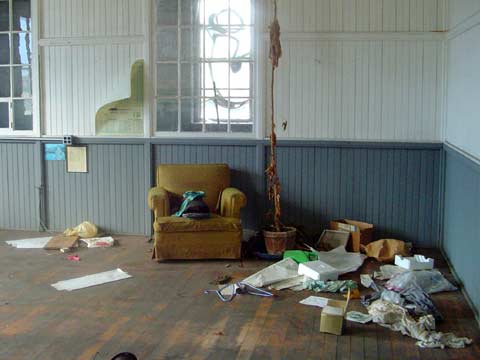
In poor neighborhoods, history is a bit more legible, more transparent. Houses are less often painted, signs less often replaced, while abandoned buildings experience a long afterlife of slow decay. Within their walls, the artifacts of the distant-recent past sometimes remain for decades, suspended in time even as time accelerates for the world around.

I remember visiting an empty Providence mill building in the mid-2000s with a friend. It was built in the 19th century and housed Thurston Manufacturing Co., maker of precision cutting saws, until its closure some time in the early 1990s. In the top floor office was a dried-up potted palm tree next to an orange armchair, the floor strewn with business letters and squatters' clothes. In a room nearby was a desk cluttered with blueprints and boiler reports going back to the 1930s. Amazing, that such ephemera could survive for more than a decade after abandonment. To be in a place like that, one feels the arrest of time, and it is a shock to the senses. Adjacent to Thurston Saw was Interstate 95, from which the angry drone of cars tearing by offered a perfect counterpoint to the stillness inside.

Thurston Saw has not made the switch to digital record keeping.
Thurston Saw does not accept web-based orders.
Thurston Saw does not enforce a no-smoking policy.

So what does this have to do with the South Bronx? Both the mills of Providence, RI and the neighborhoods of the South Bronx were casualties of the regional transition from an industrial to a 'knowledge-based' economy, along with the flight of jobs and capital to the suburbs. In both places, the built environment ceased to function as a dynamic symbol of progress, in effect ceasing to mark the passage of time-as-progress. The clock stopped for thirty years or so, and even now a few blocks remain unchanged from 'the bad old days.' To walk them is to slip through a crack in the edifice of our 'homogenous, empty time.' To do so without having to takes spirit, like opening a letter from a collections agency.

photo by Richard Townley.

Tuesday, October 20, 2009

The Global Village

Rap engages time in a unique and radical way, both through lyrical content (which invokes the past) and sampling (which appropriates its material artifacts). The influence of African diasporic cultures (especially Jamaican) and the creative possibilities opened by recording technologies are defining features of the music, and these are well known.

Less appreciated, I think, are the external adversarial forces that worked upon African-American culture in the early days of hip hop, forces that were deflected or 'flipped' into aesthetic practices. I am thinking of the postindustrial landscape of the South Bronx, where the physical decay and planned destruction of neighborhoods exposed strata of history and memory in brief flashes preceding total loss. It was a “permanent state of emergency,” and for young people, the formulation of a cultural-artistic response was a matter of life and death.

When I see pictures of the South Bronx in its saddest days, I am reminded of Walter Benjamin's 'angel of history':


There is a picture by Klee called Angelus Novus. It shows an angel who seems about to move away from something he stares at. His eyes are wide, his mouth is open, his wings are spread. This is how the angel of history must look. His face is turned towards the past. Where a chain of events appears before us, he sees one single catastrophe, which keeps piling wreckage upon wreckage and hurls it at its feet. Th angel would like to stay, awaken the dead, and make whole what has been smashed. But a storm is blowing from Paradise and has got caught in his wings; it is so strong that the angel can no longer close them. This storm drives him irresistibly into the future, to which his back is turned, while the pile of debris before him grows towards the sky. What we call progress is this storm.


The desire to “awaken the dead, and make whole what has been smashed”—this is the source of hip hop's continued vitality, and as the storm spreads to the new slums of the 'global village,' it is no wonder that the human casualties of progress adopt its basic forms.